Mutaflor oral suspension 1ml x 5 ampoules — Made in Germany — Free Delivery
(Mutaflor )


Availability: 5-10 Days

Free Shipping!
If your country is on the checkout list, we deliver to you.
US and the Rest of the World: 9 to 20 business days
Delivery Timeframes:
Europe: 7 to 18 business daysUS and the Rest of the World: 9 to 20 business days
Description Mutaflor oral suspension 1ml x 5 ampoules — Made in Germany — Free Delivery
Pharmacological properties
Pharmacodynamics. The active active ingredient is a strain of non-pathogenic bacteria that belong to the species escherichia coli (e. Coli), in a living and multiplying form: e. coli strain nissle 1917. with the help of special adhesive organelles (such as f-1a, f-1c and curly fimbriae), the strain has the ability to attach to the mucous membrane of the large intestine and form microcolonies in the form of biofilms. due to the presence of flagella, bacteria have inherent mobility, which gives them an advantage in colonizing the large intestine. The effects of the preparation Mutaflor (E. coli strain nissle 1917) have been determined in in vitro and in vivo experiments, as well as in clinical studies. such effects and mechanisms of action have been established.
Antimicrobial properties (antagonism): E. coli strain Nissle 1917 forms antimicrobial substances (microcins), which, on the one hand, are responsible for direct antagonism against pathogens, as well as for the resistance of the strain, the duration of which exceeds that of the actual oral administration of the preparation. In addition, the strain has an inhibitory effect on the invasion of enteroinvasive pathogens into the mucous membrane of the large intestine.
Stabilization of the mucous barrier of the large intestine. In experiments on cell cultures of colon epithelial cells of E. coli, the Nissle 1917 strain demonstrated the ability to stabilize the barrier function of the epithelium and normalize the increased permeability of the intestinal mucosa in general. This strengthening of the barrier function is a consequence of the stimulation of the synthesis of the fixing protein (ZO-2) and the formation with its help of strong intercellular contacts.
E. coli strain Nissle 917 has immunomodulatory properties
In vitro and in vivo studies have shown that the immunomodulatory ability of E. coli strain Nissle 1917 works both at the humoral and cellular levels of the immune system in newborns or in patients, in cases with healthy individuals, the immunomodulatory efficiency is expressed only to a small extent.
1. Influence on the specific immune system
In premature and full-term infants, after colonization (colonization) of the intestine with bacteria E. coli strain Nissle 1917, an early increase in immunocompetence was revealed, as indicated by a significant increase in the level of IgA and IgM in fecal filtrates and blood serum. In contrast, there was no increase in serum IgG levels. Some studies confirm an increase in the level of IgA in saliva. It was found that oral administration of E. coli strain Nissle 1917 is also a stimulator of a cell-mediated immune response in premature infants.
2. Influence on the non-specific immune system
Experiments in vitro and ex vivo revealed a significant increase in the secretory and cytotoxic activity of macrophages. In addition, ex vivo demonstrated an increase in the cytotoxic properties of macrophages directed against intracellular parasites, and, consequently, a stronger protection against intracellular infectious agents. In vivo, a prophylactic effect has been established for systemic infections.
In preterm infants, oral ingestion of E. coli strain Nissle 1917 has also been shown to stimulate nonspecific natural immunity.
Prokinetic properties. E. coli strain Nissle 1917 during metabolism synthesizes short-chain fatty acids, which are necessary for the optimal energy balance of the mucous membrane of the large intestine. They stimulate intestinal motility and blood circulation in its mucous membrane and enhance the absorption of sodium and chlorine ions. Stimulation of motility, which is probably due to the action of acetic acid of bacterial origin, plays an important role in the treatment of chronic constipation.
Impact on metabolism. The strain contained in the Mutaflor preparation takes part in numerous metabolic processes and is able to catabolize various carbohydrates, sugar alcohols, amino acids and other substrates, while consuming oxygen. The anaerobic environment in the lumen of the colon, created in this way, is maintained for a long time, which is very important for the stability of the intestinal ecosystem.
Pharmacokinetics. Since the active substance (E. coli strain Nissle 1917) is a commensal, it is able to colonize the intestine as a physiological bacterium, is not absorbed, is not metabolized, and is excreted from the intestine along with feces.
Toxicological properties
E. coli strain Nissle 1917 does not possess any toxic or pathogenic properties, does not form enterotoxins and hemolysins, is not enteroinvasive, seroresistant, does not possess pathogenic adhesive, uropathogenic properties, is sensitive to antibiotics, which are often used against gram-negative bacteria, does not have an immunotoxic effect.
Indications
Prevention of pathological colonization in the intestine in newborns (premature and mature); increased immunity of newborns (premature and mature); diarrhea in infants and preschool children, including tube feeding.
Application
Shake well before use! the suspension can be dripped directly into the mouth from the ampoule, for infants - before drinking, for preschool children - after eating. the suspension can also be administered via a nasogastric tube.
Prevention of colonization: premature and mature newborns - 1 ml / day for at least 5 days.
Increased immunity in newborns: the first week of life - 1 time per day, 1 ml; 2-3rd week - 3 times a week, 1 ml / day.
Diarrhea: infants and preschool children - 1 ml / day for 1-3 days. For acute diarrhea - 1 ml / day for 5 days; with prolonged diarrhea - 1 ml / day for up to 15 days.
Diarrhea when feeding through a tube: infants and preschool children - 1 time a day, 1–5 ml, up to 5 days, depending on the period of diarrhea. After achieving positive results, treatment should be continued for several more days.
Contraindications
Hypersensitivity to the ingredients of the preparation.
Side effects
The preparation is well tolerated. individual cases of undesirable effects are possible.
From the gastrointestinal tract: at the beginning of therapy, bloating is often noted, which, as a rule, disappears immediately after the dose is reduced. Abdominal pain, nausea, or vomiting were extremely rare.
On the part of the skin: in some cases, there were allergic reactions in the form of urticaria, erythema and peeling of the skin.
Infections: isolated cases of the development of sepsis in premature babies who were born very early have been described.
special instructions
When treating severe forms of diarrhea with a suspension of mutaflor, it is necessary to carry out sufficient rehydration in order to prevent and prevent exicosis (dehydration).
During pregnancy and breastfeeding. E. coli strain Nissle 1917 is a commensal bacterium that is in the human intestine and is not absorbed, does not affect the course of pregnancy and lactation, so there are no warnings regarding use during these periods.
Children. Suspension Mutaflor is used in infants and preschool children.
The ability to influence the reaction rate when driving and operating other mechanisms. Not identified.
Interactions
Antibiotics that are prescribed to affect gram-negative bacteria, as well as sulfonamides, can reduce the effectiveness of Mutaflor.
Overdose
There is no data on preparation overdose.
Storage conditions
At a temperature of 2-8 ° C.
Tags: Mutaflor
Products viewed
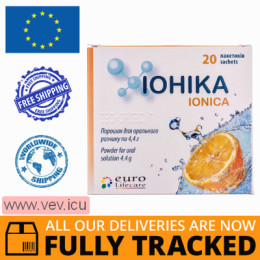
Ionica powder for oral solution 4.4g x 20 sachets — Made in India — Free Delivery
Product descriptionPowder for oral solution Ionic is used to restore water-electrolyte balance, correct acidosis in acute diarrhea (including cholera), diarrhea with mild or moderate dehydration. With thermal lesions occurring with impaired water and electrolyte metabolism.StructureActive ingredient..
$21.88
Buyers Online
- Customer from Brooklyn updated their account details
- Customer from Brooklyn logged in
- Customer from Strongsville logged in
- Customer from Brooklyn updated their account details
- Customer from Brooklyn placed a new order for VOLTAREN MAX GEL 180G - MADE IN SWITZERLAND - FREE SHIPPING
- Customer from Brooklyn logged in
- Customer placed a new order for DEBUTIR FORTE 60 СAPS — MADE IN POLAND- FREE SHIPPING
- Customer from Ottawa updated their account details
- Customer from Ottawa registered for an account
- Customer placed a new order for STRESAM 50MG 60 PILLS - MADE IN FRANCE - FREE SHIPPING
- Customer placed a new order for ACNE-DERM Cream 2p x 20Gr — Made in Poland by Uniapharm — Free Delivery
- Customer placed a new order for Ascorbic acid 0,05g 2p x 160 tablets — Made in Ukraine — Free Delivery
- Customer placed a new order for Fanigan 100 tablets — Made in India — Free Delivery
- Customer from Raleigh placed a new order for Essentiale Forte 300 mg, 2p x 50 capsules — Made in Poland — Free Delivery
- Customer from Raleigh logged in
- Customer placed a new order for TENOTEN FOR CHILDREN 40 PILLS — MADE IN LITHUANIA — FREE SHIPPING
- Customer from Raleigh logged in
- Customer placed a new order for Aqua Maris for Children from Birth nasal drops 10 ml — Made in Croatia — Free Deliver
- Customer from Raleigh logged in
- Customer from Raleigh placed a new order for Essentiale Forte 300 mg, 2p x 50 capsules — Made in Poland — Free Delivery