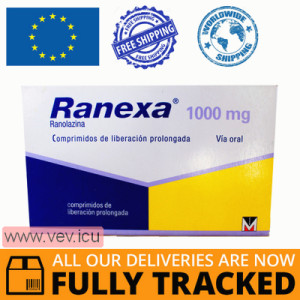
Ranexa 1000, 1000mg 60 tablets — Made in Germany — Free Delivery


US and the Rest of the World: 9 to 20 business days
Description Ranexa 1000, 1000mg 60 tablets — Made in Germany — Free Delivery
Pharmacological properties
Pharmacodynamics. Until now, the mechanism of action of ranolazine remains largely unknown. ranolazine can have some antianginal effect by inhibiting the late flow of sodium ions into myocardial cells, reduces intracellular sodium accumulation and, accordingly, reduces the excess of intracellular calcium ions. It is believed that ranolazine, by reducing the late flow of sodium ions, reduces the intracellular ionic imbalance during ischemia. it can be expected that such a decrease in the excess of intracellular calcium will promote relaxation of the myocardium and, thus, reduce ventricular diastolic tension. clinical evidence of inhibition of late sodium current under the influence of ranolazine is a significant reduction in the q – tc interval and a positive effect on diastolic relaxation in patients with prolonged q – t interval syndrome. these effects of the preparation do not depend on a decrease in heart rate, blood pressure or vasodilation.
Influence on hemodynamics. Clinical studies have shown that in patients who received ranolazine alone or in combination with other preparations intended for the treatment of angina pectoris, there was a decrease in mean heart rate (2 beats / min) and mean systolic blood pressure (3 mm Hg).
Effects on the ECG. In patients who received this preparation, an increase in the Q – Tc interval was observed, which depended on the dose and concentration in the blood plasma (approximately 6 ms with the use of 1000 mg 2 times a day), a decrease in the amplitude of the T wave and, in some cases, double-peaked T waves. It is believed that this effect of ranolazine on ECG performance is the result of inhibition of the rapid potassium current of the rectifier channel, which lengthens the ventricular action potential, and also inhibits the late sodium current, which reduces the ventricular action potential. Studies have shown the dependence of the lengthening of the Q-Tc interval on the concentration equal to 2.4 ms per 1000 ng / ml ranolazine in the blood plasma, which is approximately equal to the lengthening from 2 to 7 ms for the concentration range corresponding to the dose from 500 to 1000 mg 2 times a day ... The lengthening rate was higher in patients with clinically significant liver failure.
Pharmacokinetics. After oral administration of Ranexa, Cmax of ranolazine in blood plasma, as a rule, is observed after 2–6 hours. When used twice a day, an equilibrium state is usually achieved within 3 days.
Suction. The average bioavailability of ranolazine after oral administration of immediate-release tablets is 35-50%, with a high degree of individual variance. The effect of the preparation Ranexa increases depending on the dose. When the dose is increased from 500 to 1000 mg 2 times a day, a 2.5–3-fold increase in AUC is observed in the equilibrium state. The meal time did not affect the rate and completeness of absorption.
Distribution. Approximately 62% of ranolazine binds to blood plasma proteins. The average volume of distribution at steady state (Vss) is approximately 180 liters.
Excretion. Ranolazine is excreted mainly by metabolic pathway. Less than 5% of the dose is excreted unchanged in the urine and feces. After oral administration of a single dose of 500 mg labeled with radioactive carbon [14C] ranolazine by healthy individuals, 73% of radioactivity is determined in urine and 25% in feces. The clearance of ranolazine is dose-dependent, decreasing with increasing dose. T½ is approximately 2-3 hours after the on / in the introduction. Terminal T1 / 2 in equilibrium after oral administration of ranolazine is approximately 7 hours, which is due to the limitation of the rate of excretion by rapid absorption.
Biotransformation. Ranolazine undergoes a rapid and extensive metabolism. In healthy young volunteers, after a single oral intake of 500 mg of radioactive carbon-labeled ranolazine, 13% of radioactivity is determined in blood plasma. A large number of metabolites were found in human blood plasma (47 metabolites), urine (100 metabolites) and feces (25 metabolites). 14 major metabolic pathways have been identified, among which O-demethylation and N-dealkylation are the most important. In vitro studies using human liver microsomes have shown that ranolazine is metabolized by CYP 3A4 as well as CYP 2D6. When 500 mg ranolazine is used 2 times a day in people with insufficient CYP 2D6 activity, the AUC indicator exceeds the same value in people with normal CYP 2D6 activity by 62%. The corresponding difference for a dose of 1000 mg twice a day was 25%.
Special patient groups. Influence of gender. Gender has no clinical effect on pharmacokinetic parameters.
Elderly patients. Elderly age also has no clinical effect on pharmacokinetic parameters, however, in elderly people, an increased effect of ranolazine is possible due to age-related decline in renal function.
Body mass. In persons weighing 40 kg, the effect of ranolazine is approximately 1.4 times greater than in persons weighing 70 kg.
Congestive heart failure (CHF). CHF (NYHA classes III – IV) leads to an increase in the concentration of ranolazine in the blood plasma by 1.3 times.
Renal failure Studies have shown that in patients with mild, moderate or severe renal insufficiency, the AUC indicator was, on average, 1.7–2 times higher than in those with normal renal function. Also, there was a significant individual variance in the value of AUC in patients with renal failure. AUC of metabolites increases with a decrease in renal function. The studies revealed an increase in the effect of ranolazine by 1.2 times in patients with moderate renal insufficiency (creatinine clearance - 40 ml / min) and 1.3-1.8 times in patients with severe renal insufficiency (creatinine clearance - 10-30 ml / min).
Liver failure. There is no experience with ranolazine in patients with severe hepatic impairment. In individuals with mild hepatic insufficiency, the AUC value of ranolazine does not change, and in patients with moderate hepatic insufficiency, the AUC value increases 1.8 times. In such patients, a more pronounced increase in the Q – T interval.
Indications
Treatment of stable angina pectoris.
Application
The tablets should be swallowed whole (without crushing, breaking, chewing). the preparation can be taken with or without food.
Adults. The recommended initial dose of Ranexa is 500 mg 2 times a day. After 2-4 weeks, the dose, if necessary, can be increased to 1000 mg 2 times a day. The maximum recommended dose is 1000 mg 2 times a day. If the patient has adverse reactions caused by the use of the preparation (for example, dizziness, nausea, vomiting), then the dose can be reduced to 500 mg. Treatment is stopped if adverse reactions persist.
Concomitant use with moderate-potency CYP 3A4 inhibitors (eg diltiazem, fluconazole, erythromycin) and P-gp inhibitors (eg verapamil, cyclosporin). If patients receive these preparations, careful and careful dose selection is recommended.
Renal failure Patients with renal insufficiency of mild to moderate severity (creatinine clearance ≥30–80 ml / min) are advised to carefully and carefully select the dose.
Liver failure. Patients with mild hepatic impairment are advised to carefully and carefully select the dose.
Elderly patients. The selection of the dose for this category of patients should be carried out with caution due to the fact that in old age an age-related decrease in renal function is possible, and the effect of ranolazine may increase. Elderly patients have an increased incidence of adverse reactions.
Insufficient body weight. An increased incidence of adverse reactions is characteristic of patients with insufficient body weight (≤60 kg), therefore, dose selection for this category of patients should be carried out with caution.
ZSN. Dose selection should be done with caution in patients with moderate to severe CHF (NYHA grades III – IV).
Contraindications
Hypersensitivity to the active substance or to any excipient of the preparation. severe renal failure (creatinine clearance 30 ml / min). liver failure of moderate or severe degree. the simultaneous use of powerful inhibitors of cyp 3a4 (for example, itraconazole, ketoconazole, voriconazole, posaconazole, HIV protease inhibitors, clarithromycin, telithromycin, nefazodone). concomitant use of class ia (quinidine) or class iii antiarrhythmics (for example, dofetilide, sotalol), except for amiodarone.
Side effects
Below are the adverse reactions associated with the use of the preparation, classified by body systems, organ classes and absolute frequency. frequency was determined as follows: very often (? 1/10), often (? 1/100 to 1/10), infrequently (? 1/1000 to 1/100), rarely (? 1/10 000 to 1/1000) , very rare (1/10 000).
From the side of metabolism and nutrition: infrequently - anorexia, loss of appetite, dehydration; rarely, hyponatremia.
From the side of the psyche: infrequently - anxiety, insomnia, confusion, hallucinations; rarely, disorientation.
From the side of the nervous system: often - dizziness, headache; infrequently - lethargy, loss of consciousness, hypesthesia, drowsiness, tremors, postural dizziness; rarely - amnesia, clouding of consciousness, loss of consciousness, parosmia, impaired coordination, impaired gait.
From the side of the organ of vision: infrequently - blurred vision, visual disturbances, diplopia.
On the part of the organ of hearing and balance: infrequently - dizziness, tinnitus; rarely - hearing loss.
From the side of the vessels: infrequently - hot flashes, arterial hypotension; rarely - cold extremities, orthostatic hypotension.
From the respiratory system: infrequently - shortness of breath, cough, nosebleeds; rarely - a feeling of constriction in the throat.
From the digestive system: often - constipation, nausea, vomiting; infrequently - abdominal pain, dry mouth, dyspepsia, flatulence, stomach discomfort; rarely - pancreatitis, erosive duodenitis, oral hypesthesia.
On the part of the skin and subcutaneous fat: infrequently - itching, hyperhidrosis; rarely - angioedema, allergic dermatitis, urticaria, cold sweat, rash.
From the musculoskeletal system and connective tissue: infrequently - pain in the limbs, muscle spasms, swelling of the joints; rarely - myasthenia gravis.
From the side of the kidneys and urinary tract: infrequently - dysuria, hematuria, chromaturia; rarely - acute renal failure, urinary retention.
From the reproductive system and mammary glands: rarely - erectile dysfunction.
Systemic disorders: often - asthenia; infrequently - fatigue, peripheral edema.
Data from additional research methods: infrequently - an increased level of creatinine in the blood, an increased level of urea in the blood, an increase in the corrected Q – T interval, an increase in the number of platelets or white blood cells, a decrease in body weight; rarely - an increase in the level of liver enzymes in the blood.
Older age, renal failure and underweight: in general, adverse reactions occurred more often among elderly patients and those with renal failure, however, the types of events in these subgroups were similar to those observed in the general group of patients. In elderly patients (≥75 years old) compared with younger patients (75 years old), when using the preparation, side reactions such as constipation, nausea, arterial hypotension, and vomiting were more common.
In patients with renal insufficiency of mild to moderate severity (creatinine clearance ≥30-80 ml / min) compared with patients with normal renal function (creatinine clearance 80 ml / min), taking into account the placebo-corrected frequency, constipation occurred more often when using the preparation, nausea, dizziness.
As a rule, the type and frequency of adverse reactions observed in patients with low body weight (≤60 kg) were similar to similar reactions in patients with higher body weight (60 kg), but in patients with underweight, placebo-corrected frequency was higher for such common phenomena as nausea, vomiting, arterial hypotension.
Laboratory research methods. In healthy volunteers and in patients treated with Ranexa, a slight reversible increase in serum creatinine levels was noted, which has no clinical significance. Renal failure was not associated with this phenomenon. The study of renal function in healthy volunteers showed a decrease in creatinine clearance in the absence of changes in the glomerular filtration rate, which is consistent with inhibition of renal tubular secretion of creatinine.
Post-marketing experience. In the post-marketing experience, there were no reports of ARF occurrence. The use of concomitant preparations (for example, other antianginal preparations), as well as the presence of diabetes mellitus, class I and II heart failure or obstructive airway disease in patients did not have a significant effect on the frequency of adverse reactions.
Special instructions
Care should be taken when using or increasing the dose of ranolazine to patients for whom an increase in its action may be expected, in the following conditions:
- concomitant use of moderate-potency CYP 3A4 inhibitors;
- concomitant use of P-gp inhibitors;
- mild hepatic impairment;
- renal failure of mild or moderate severity (creatinine clearance - 30–80 ml / min);
- old age of the patient;
- underweight (≤60 kg);
Moderate or severe CHF (NYHA grades III – IV).
In patients with several of the above factors, an additional enhancement of the action can be expected. Possible adverse reactions that depend on the dose. When using ranolazine in patients with a combination of several of these factors, frequent monitoring of adverse reactions is required, and, if necessary, the dose of ranolazine should be reduced or discontinued.
The risk of increased action of ranolazine, which leads to an increase in the frequency of adverse reactions in these groups, increases in patients with insufficient CYP 2D6 activity (persons with reduced metabolism) compared with patients with normal CYP 2D6 activity (patients with intensive metabolism). The above precautions are designed to take into account the potential risk to patients with reduced CYP 2D6 metabolism and should be considered when the CYP 2D6 metabolism status is unknown. For patients with intensive metabolism of CYP 2D6, such reservations are of less importance. In patients for whom the normal metabolic status of CYP 2D6 has been determined (for example, by genotyping) or was previously known, ranolazine can be used with caution if the patient has several of the above risk factors.
Elongation of the Q – T interval. Caution is required when treating patients with a history of congenital lengthening of the Q-T interval or with a family history of hereditary lengthening of the Q-T interval, or with a known acquired lengthening of the Q-T interval, as well as patients receiving preparations that affect the duration of the Q-T interval –Tc (see INTERACTIONS and PHARMACOLOGICAL PROPERTIES).
Renal failure Kidney function declines with age, so it is important to check it regularly when using ranolazine.
Lactose. The preparation contains lactose, so it should not be used in patients with rare congenital galactose intolerance, lactase deficiency or impaired absorption of glucose and galactose.
Use during pregnancy and lactation. The necessary data on the use of ranolazine in pregnant women are absent, and the data obtained as a result of animal experiments are insufficient to assess the effect on pregnancy and embryo development. The potential risk to humans is unknown. Ranexa preparation should not be used during pregnancy, unless absolutely necessary.
It is not known whether ranolazine passes into breast milk. The release of ranolazine into breast milk has not been studied in animals, so Ranexa should not be used in women during breastfeeding.
Children. It is not recommended to use Ranexa in children (under 18 years of age) due to insufficient data on safety and efficacy.
The ability to influence the reaction rate when driving or working with other mechanisms. Ranolazine can cause dizziness and blurred vision, double vision, confusion, poor coordination and hallucinations, which can adversely affect the ability to drive or operate machinery.
Interactions
Effect of other preparations on ranolazine
Inhibitors of CYP 3A4 and P-gp. Ranolazine is a substrate of CYP 3A4, therefore CYP 3A4 inhibitors increase the concentration of ranolazine in blood plasma. With an increase in its concentration in blood plasma, the manifestation of potential adverse reactions, which depend on the dose (for example, nausea, dizziness), may increase. The simultaneous use of ketoconazole at a dose of 200 mg 2 times a day increases the AUC of ranolazine by 3–3.9 times. Grapefruit juice is also a potent inhibitor of CYP 3A4.
Diltiazem (180-360 mg 1 time per day), a medium-potency CYP 3A4 inhibitor, increases the mean equilibrium concentrations of ranolazine by 1.5-2.4 times, depending on the dose. For patients receiving diltiazem and other moderate-potency CYP 3A4 inhibitors (eg erythromycin, fluconazole), careful and careful selection of the dose of Ranexa is recommended. It may be necessary to reduce the dose of the preparation.
Ranolazine is a P-gp substrate. P-gp inhibitors (for example, cyclosporine, verapamil) increase the concentration of ranolazine in the blood plasma. Verapamil (120 mg 3 times a day) increases the equilibrium concentration of ranolazine in blood plasma by 2.2 times. For patients taking P-gp inhibitors, careful and careful selection of the dose of Ranexa is recommended. It may be necessary to reduce the dose of the preparation.
CYP 3A4 inductors. Rifampicin (600 mg once a day) reduces the equilibrium concentrations of ranolazine by about 95%. You should not start treatment with Ranexa when using CYP 3A4 inducers (rifampicin, phenytoin, phenobarbital, carbamazepine, St. John's wort).
Inhibitors of CYP 2D6. Ranolazine is partially metabolized by CYP 2D6, therefore, CYP 2D6 inhibitors can increase the concentration of ranolazine in blood plasma. A powerful inhibitor of CYP 2D6 paroxetine (20 mg 1 time per day) increases the mean equilibrium concentration of ranolazine in blood plasma by 1.2 times (when using ranolazine 1000 mg 2 times a day). No dose adjustment is required. At a dose of 500 mg ranolazine 2 times a day, the simultaneous use of a potent inhibitor of CYP 2D6 can lead to an increase in the AUC of ranolazine by about 62%.
The effect of ranolazine on other preparations. Ranolazine is an inhibitor of P-gp (medium to strong effect) and a weak inhibitor of CYP 3A4, therefore, it can increase the concentration of substrates of these enzymes in blood plasma. The distribution of preparations transported by P-gp may also increase. Available data indicate that ranolazine is a weak inhibitor of CYP 2D6. The use of ranolazine 750 mg 2 times a day increases the concentration of metoprolol in the blood plasma by 1.8 times, therefore, with their simultaneous use, the effect of metoprolol or other CYP 2D6 substrates (for example, propafenone, flecainide; to a lesser extent this applies to tricyclic antidepressants and antipsychotics) ), so a dose reduction of these preparations may be required. The potential to inhibit CYP 2B6 has not been established. Caution is advised when ranolazine is used concomitantly with CYP 2B6 substrates (eg bupropion, efavirenz, cyclophosphamide).
Digoxin. There is evidence of an increase in the concentration of digoxin in the blood plasma by an average of 1.5 times with simultaneous use with the preparation Ranex, therefore it is necessary to monitor the level of digoxin at the beginning and at the end of the use of the preparation Ranex.
Simvastatin. The metabolism and clearance of simvastatin is highly dependent on CYP 3A4. The use of the Ranex preparation at a dose of 1000 mg 2 times a day increases the concentration of lactone simvastatin, simvastatinic acid by about 2 times.
An association was noted between the use of high doses of simvastatin and the development of rhabdomyolysis. Also, as part of post-marketing surveillance, cases of rhabdomyolysis were reported in patients taking ranolazine and simvastatin. For patients taking ranolazine at any dose, the dose of simvastatin should not exceed 20 mg / day.
Atorvastatin. The use of ranolazine at a dose of 1000 mg 2 times a day increases the Cmax and AUC of atorvastatin, which is used at a dose of 80 mg once a day, by 1.4 and 1.3 times, respectively, and changes the Cmax and AUC of atorvastatin metabolites by less than 35% ... When using ranolazine, it may be necessary to limit the dose of atorvastatin and conduct appropriate clinical observation. Also, when taking ranolazine, it may be necessary to limit the dose of other statins metabolized by CYP 3A4 (for example, lovastatin).
Tacrolimus, cyclosporine, sirolimus, everolimus. The use of ranolazine in patients receiving tacrolimus (a substrate of CYP 3A4) led to an increase in the concentration of the latter in the blood plasma. In the case of prescribing the preparation to patients receiving tacrolimus, it is recommended to monitor the concentration of tacrolimus in the blood plasma and, if necessary, adjust the dose of tacrolimus. Such control is also recommended when using other CYP 3A4 substrates with a narrow therapeutic range (eg cyclosporine, sirolimus, everolimus).
Medicines transported by organic cation transporter 2 (OCT2). When ranolazine was used at a dose of 500 and 1000 mg 2 times a day in patients with type II diabetes mellitus, the concentration of simultaneously applied metformin (1000 mg 2 times a day) in the blood plasma increased by 1.4 and 1.8 times, respectively. The concentration of other OCT2 substrates, including pindolol and varenicline, may vary equally.
With the simultaneous use of ranolazine and other preparations that lengthen the Q – Tc interval, pharmacodynamic interactions may occur and the risk of ventricular arrhythmias may increase. These preparations include some antihistamines (eg terfenadine, astemizole, mizolastine), some antiarrhythmics (eg quinidine, disopyramide, procainamide), erythromycin, and cyclic antidepressants (eg imipramine, doxepin, amitriptyline).
Overdose
When studying the tolerance of increasing the dose of the preparation administered orally in patients with angina pectoris, the incidence of dizziness, nausea, and vomiting increased in accordance with the dose. in case of an overdose, the patient requires careful monitoring; symptomatic and supportive therapy is recommended. since about 62% of ranolazine binds to plasma proteins, complete elimination during hemodialysis is unlikely.
Storage conditions
Does not require special storage conditions.
Tags: Ranexa
Products viewed

Viraxa 500mg 14 tablets — Made in Greece — Free Delivery
Product descriptionViraxa tablets are indicated for:Varicella Zoster virus (VZV) infections - shingles.Infections caused by Herpes Simplex viruses (HSV) - genital herpes.CompoundActive ingredient: famciclovir;1 tablet contains 125 mg or 250 mg or 500 mg of famciclovir;Excipients: corn starch, sodium..
$56.53

MYDOCALM 150MG 30 TABS — MADE IN HUNGARY — FREE SHIPPING
Product descriptionTablets "Mydocalm" are used for the symptomatic treatment of muscle spasm in adults after a stroke.CompositionThe active ingredient is tolperisone hydrochloride (one coated tablet contains 150 mg of tolperisone hydrochloride).Excipients:core: citric acid, monohydrate; colloidal an..
$33.43

AVILIN BALSAM GASTRO 110ML - MADE IN POLAND - FREE SHIPPING
AVILIN BALSAM GASTRO 110MLThe balm protects the gastrointestinal mucosa against aggressive and unfavorable external factors.The original recipe of the balm by prof. Shostakowski for internal use.CompositionPolymer E (polyvinyl butyl ether)Usage methodTake a tablespoon (15ml) - once a day in the even..
$48.99
Omez DSR 30 capsules — Made in India — Free Delivery
Pharmacological propertiesPharmacodynamics. A combined preparation, the action of which is due to the components that make up its composition.Omeprazole belongs to antiulcer preparations that suppress basal and stimulated secretion of hydrochloric acid in the parietal cells of the stomach due to a s..
$21.88

Vitacap 30 soft capsules — Made in Thailand — Free Delivery
Pharmacological propertiesPharmacodynamics. Vitamins play an important biological role in regulating many biochemical processes in the body. in the metabolism of carbohydrates, fats and proteins, as well as in the functioning of the nervous system, vitamins of group B (B1, B2, B6) take part. vitamin..
$21.88
Buyers Online
- Customer from Brooklyn updated their account details
- Customer from Brooklyn logged in
- Customer from Strongsville logged in
- Customer from Brooklyn updated their account details
- Customer from Brooklyn placed a new order for VOLTAREN MAX GEL 180G - MADE IN SWITZERLAND - FREE SHIPPING
- Customer from Brooklyn logged in
- Customer placed a new order for DEBUTIR FORTE 60 СAPS — MADE IN POLAND- FREE SHIPPING
- Customer from Ottawa updated their account details
- Customer from Ottawa registered for an account
- Customer placed a new order for STRESAM 50MG 60 PILLS - MADE IN FRANCE - FREE SHIPPING
- Customer placed a new order for ACNE-DERM Cream 2p x 20Gr — Made in Poland by Uniapharm — Free Delivery
- Customer placed a new order for Ascorbic acid 0,05g 2p x 160 tablets — Made in Ukraine — Free Delivery
- Customer placed a new order for Fanigan 100 tablets — Made in India — Free Delivery
- Customer from Raleigh placed a new order for Essentiale Forte 300 mg, 2p x 50 capsules — Made in Poland — Free Delivery
- Customer from Raleigh logged in
- Customer placed a new order for TENOTEN FOR CHILDREN 40 PILLS — MADE IN LITHUANIA — FREE SHIPPING
- Customer from Raleigh logged in
- Customer placed a new order for Aqua Maris for Children from Birth nasal drops 10 ml — Made in Croatia — Free Deliver
- Customer from Raleigh logged in
- Customer from Raleigh placed a new order for Essentiale Forte 300 mg, 2p x 50 capsules — Made in Poland — Free Delivery