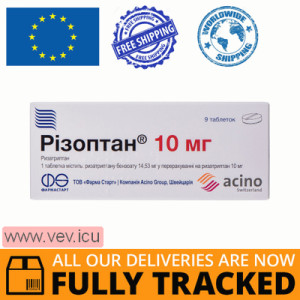
Rizoptan 10 mg 9 tablets — Made in Switzerland — Free Delivery


US and the Rest of the World: 9 to 20 business days
Description Rizoptan 10 mg 9 tablets — Made in Switzerland — Free Delivery
Pharmacological properties
Pharmacodynamics. Rizoptan binds selectively with high affinity to human 5-ht1b and 5-ht1d receptors and has little or no effect on 5-ht2, 5-ht3; adrenergic α1, α2 or β; dopaminergic d1, d2; histamine h1; muscarinic or benzodiazepine receptors.
The therapeutic activity of Rizoptan in migraine headache can be explained by its agonistic effect on the 5-HT1B and 5-HT1D receptors of extracerebral intracranial blood vessels, which are believed to dilate during an attack, and the trigeminal sensory nerves that innervate them. Activation of 5-HT1B and 5-HT1D receptors can lead to narrowing of intracranial blood vessels, which cause pain, and inhibition of neuropeptide release, which leads to a decrease in the severity of inflammation of sensitive tissues and a decrease in the transmission of the central trigeminal pain signal.
Pharmacokinetics. Absorption. After oral administration, Rizoptan is rapidly and completely absorbed. The oral bioavailability of tablets is approximately 40–45%, and Cmax in blood plasma is reached after 1–1.5 h (Tmax). Oral intake of Rizoptan with a high-fat breakfast does not affect absorption of Rizoptan , but absorption is delayed by about 1 hour.
Influence of food: Tmax is delayed by about 1 hour if the tablets are taken in a state of fullness.
Distribution. Rizoptan minimally (14%) binds to blood plasma proteins. The volume of distribution is approximately 140 liters in men and 110 liters in women.
Metabolism. The primary metabolic pathway of Rizoptan is through oxidative deamination of monoamine oxidase (MAO) subtype A (MAO-A) to an indoleacetic acid metabolite, which is not pharmacologically active. A small amount of N-monodesmethyl-Rizoptan is formed, a metabolite whose activity is similar to the activity of the primary substance at the 5-HT1B / 1D receptors, but does not significantly affect the pharmacodynamic activity of Rizoptan . The plasma concentration of N-monodesmethyl-Rizoptan is approximately 14% of the concentration of the primary substance, the compound is excreted at the same rate. Other minor metabolites include N-oxide, 6-hydroxy compound, and 6-hydroxy metabolite sulfate conjugate. None of these minor metabolites exhibit pharmacological activity.
Excretion. After taking a dose above the dose range of 2.5-10 mg, the area under the curve (AUC) increases almost proportionally. In men and women, the half-life of Rizoptan in blood plasma averages 2–3 hours. The clearance of Rizoptan in blood plasma averages about 1000–1500 ml / min in men and about 900–1100 ml / min in women; about 20-30% is renal clearance. After taking 14C-labeled Rizoptan, about 80% of the radioactivity is excreted in the urine and about 10% in the feces. This indicates that metabolites are mainly excreted by the kidneys.
According to the presystemic metabolism of Rizoptan, approximately 14% of an oral dose is excreted unchanged in the urine, while 51% is excreted as the indoleacetic acid metabolite. No more than 1% is excreted in the urine in the form of an active metabolite of N-monodesmethyl.
If Rizoptan is taken in maximum doses, there is no daily accumulation of the preparation in the blood plasma.
Characteristics in different patients
Patients with a migraine attack: A migraine attack does not affect the pharmacokinetics of Rizoptan .
Gender: in men, the AUC of risatriptan (10 mg orally) was about 25% less than in women, the Cmax was 11% less, and the Tmax was about the same. This apparent pharmacokinetic difference is of no clinical relevance.
Elderly patients: plasma concentrations of Rizoptan are similar to those in young patients.
Patients with impaired liver function (the severity of liver failure according to Child - Pugh - 5-6 points): it is known that after oral administration in patients with hepatic impairment, the concentration of Rizoptan in the blood plasma was similar to the concentration in young men and women who participated in research. A significant increase in AUC (by 50%) and Cmax (by 25%) was observed in patients with moderate hepatic impairment (the severity of hepatic impairment according to Child - Pugh - 7 points). In patients with severe hepatic impairment according to Child-Pugh 7 points (severe hepatic impairment), pharmacokinetics were not studied.
Patients with impaired renal function: it is known that in individuals with renal insufficiency (creatinine clearance - 10-60 ml / min / 1.73 m2), the AUC of Rizoptan did not differ significantly from that in healthy patients. In patients on hemodialysis (creatinine clearance 10 ml / min / 1.73 m2), the AUC of Rizoptan was approximately 44% higher than in those with normal renal function. Cmax of Rizoptan in blood plasma in patients with renal insufficiency of any degree was the same as in healthy patients.
Indications
Emergency headache phase therapy for migraine attacks, with or without aura.
Application
Used internally. do not use risoptan for prophylactic purposes.
The tablets should be swallowed whole with some liquid.
The absorption time is delayed by about 1 hour if the preparation is taken in a satiated state.
The recommended dose is 10 mg.
Repeated intake: the next dose can be taken no earlier than 2 hours later; a maximum of two doses can be taken over a 24-hour period.
If the headache recurs within 24 hours, if the headache returns after the initial attack has been relieved, another dose can be taken. The above dosage rates must be observed.
No response: The efficacy of a repeat dose to treat the same attack when the first dose failed has not been tested in trials of Rizoptan . Thus, if after taking the first dose the patient does not have a therapeutic effect, the second dose should not be taken to treat the same attack.
Studies of Rizoptan have shown that even in the absence of a therapeutic effect during one attack, the likelihood of a therapeutic effect in the following attacks remains.
Some patients should be given a low dose of Risotriptan (5 mg), especially in these groups:
patients taking propranolol. Rizoptan should be taken no earlier than 2 hours after taking propranolol;
patients with mild to moderate renal impairment;
patients with mild to moderate hepatic impairment.
The time interval between taking two doses should be at least 2 hours; a maximum of two doses can be taken over a 24-hour period.
Patients over the age of 65. The efficacy and safety of taking Rizoptan in patients over the age of 65 have not been systematically studied.
Contraindications
Hypersensitivity to Rizoptan or any excipient. simultaneous use with MAO inhibitors or use within 2 weeks from the moment of termination of treatment with MAO inhibitors. severe hepatic or severe renal impairment. violation of cerebral circulation or transient ischemic attack in history. moderate to severe arthritis, and untreated mild arthritis. established coronary artery disease, including coronary artery disease (angina pectoris, a history of myocardial infarction or fixed asymptomatic ischemia), signs and symptoms of coronary artery disease or prinzmetal angina. peripheral vascular disease. concomitant use of Rizoptan and ergotamine, derivatives of ergot alkaloids (including methysergide) or other 5-ht1b / 1d receptor agonists.
Side effects
The most common side effects are dizziness, drowsiness, and weakness / fatigue. the frequency of adverse reactions is defined as follows: very often (10%); often (1-10%); infrequently (0.1-1%); single (0.01–0.1%); rarely (0.01%); the frequency is unknown (cannot be estimated from the available data).
From the side of the immune system: single - allergic reactions, anaphylactic shock / anaphylactoid reactions.
From the side of the psyche: often - insomnia; infrequently - disorientation, irritability.
From the nervous system: often - dizziness, drowsiness, paresthesia, headache, hypesthesia, decreased mental activity; infrequently - ataxia, tremor, vertigo, dysgeusia / unpleasant taste, fainting; frequency unknown - seizures, serotonin syndrome.
From the side of the organ of vision: infrequently - blurred vision.
From the side of the cardiovascular system: often - palpitations, hot flashes; infrequently - arrhythmia, tachycardia, changes in the ECG, hypertension; isolated - cerebrovascular accident (according to reports, most of these adverse reactions occurred in patients with risk factors for coronary artery disease), bradycardia; the frequency is unknown - ischemia or myocardial infarction (according to reports, most of these adverse reactions occurred in patients with risk factors for coronary artery disease), peripheral vascular ischemia.
From the respiratory system, chest and mediastinal organs: often - discomfort in the throat; infrequently - shortness of breath; single - wheezing.
From the digestive system: often - nausea, dry mouth, vomiting, diarrhea, dyspepsia; infrequently - a feeling of thirst; frequency unknown - ischemic colitis.
On the part of the skin and subcutaneous tissues: often - redness; infrequently - itching, urticaria, angioedema (eg, swelling of the face, tongue, and swelling of the pharynx), rash, increased sweating; frequency unknown - toxic epidermal necrolysis.
On the part of skeletal muscles and connective tissue: often - a feeling of heaviness; infrequently - neck pain, stiffness, stiffness, muscle weakness, facial pain, myalgia.
General disorders: often - asthenia / fatigue, abdominal or chest pain.
Special instructions
Risoptan should not be used for prophylaxis.
Effect of food: when taken simultaneously with food, the absorption of Rizoptan is delayed by about 1 hour. Therefore, the onset of action of the preparation can be delayed if taken in a state of satiety (see PHARMACOLOGICAL PROPERTIES).
Risoptan should be prescribed only to those patients who have an accurate diagnosis of migraine. Risoptan should not be administered to patients with basilar or hemiplegic migraine.
Risoptan should not be used to treat atypical headache, that is, one that may be associated with potentially serious diseases (for example, stroke, ruptured aneurysm), in which the narrowing of the cerebrovascular vessels can be dangerous.
Taking risatriptan can be associated with transient symptoms, including chest pain and tightness in the chest, which can become intense and involve the throat. If such symptoms raise suspicion of coronary artery disease, the preparation should be discontinued and a proper examination carried out.
Like other 5-HT1B / 1D receptor agonists, Rizoptan should not be given without prior screening to patients likely to have heart disease and those at risk of developing coronary nicotine therapy, men over the age of 40, women in the postmenopausal period, patients with interventricular blockade and those with a family history of severe coronary artery disease). Cardiac examination may not identify all patients with heart disease, and in very rare cases, serious heart complications have been observed with 5-HT1 receptor agonists in patients without existing cardiovascular disease. Rizoptan should not be prescribed to patients with diagnosed coronary atherosclerosis (see CONTRAINDICATIONS).
5-HT1B / 1D receptor agonists are associated with coronary spasm. In some cases, the development of ischemia or myocardial infarction has been reported with the use of 5-HT1B / 1D receptor agonists.
Other 5-HT1B / 1D receptor agonists (eg sumatriptan) should not be administered concomitantly with risatriptan.
It is recommended to wait at least 6 hours after taking Rizoptan before taking ergotamine-type preparations (eg ergotamine, dihydroergotamine, or methysergide). Before taking Rizoptan , you need to make sure that less than 24 hours have passed since the last dose of preparations containing ergotamine.
After the simultaneous use of triptans and selective serotonin reuptake inhibitors or norepinephrine and serotonin reuptake inhibitors, serotonin syndrome (including altered mental status, autonomic nervous system disorder and neuromuscular disorders) has been reported. These reactions can be serious. If the simultaneous use of Rizoptan and selective serotonin reuptake inhibitors or norepinephrine and serotonin reuptake inhibitors is consistent with clinical indications, it is recommended to carry out appropriate monitoring of the patient's health, especially at the beginning of treatment, during the period of increasing doses or when adding another serotonergic agent.
Side effects are more likely to occur with the simultaneous use of triptans (5-HT1B / 1D agonists) and herbal preparations containing St. John's wort (Hypericum perforatum).
Quincke's edema (eg, swelling of the face, tongue, and larynx) may occur in patients taking triptans, which include Rizoptan . If angioedema of the tongue or pharynx occurs, the patient should be monitored until symptoms disappear. Treatment with triptans should be discontinued immediately and replaced with a preparation belonging to a different class of preparations.
The preparation contains lactose, so patients with rare hereditary problems of galactose intolerance, Lapp lactase deficiency or glucose-galactose malabsorption syndrome should not take it.
Potential interactions should be considered when prescribing risatriptan to patients using CYP 2D6 substrates.
Headache caused by overuse of the preparation. Long-term use of any headache pain reliever can make the headache worse. If such a situation arises (or there is a suspicion of it), it is necessary to consult a doctor and stop treatment. Overuse headache may be suspected in patients who have frequent or daily headaches despite taking regular headache medications.
Use during pregnancy and lactation. Reproductive function. The effect on the human body has not been studied. It is known that animal studies have shown minimal effects on reproductive function at plasma concentrations that are much higher than therapeutic concentrations for humans (more than 500 times).
Application during pregnancy. The safety of using risatriptan for pregnant women has not been established. It is known that animal studies, which took into account the development of the embryo / fetus or the course of pregnancy, labor and postpartum development, did not show harmful effects at a dose in excess of therapeutic dosage levels for humans.
Since studies of the reproductive function and intrauterine development of animals do not always predict the response of the human body, Rizoptan should be prescribed during pregnancy only if absolutely necessary.
Application during lactation. Rizoptan has been reported to be excreted in large quantities in milk in animal studies. A transient, barely noticeable decrease in body weight in offspring that feeds on mother's milk was observed only when the systemic effect on the mother's body was much higher than the maximum exposure level for humans. No data available for humans.
Therefore, caution should be exercised when using risatriptan for breastfeeding women. The effect on the infant should be minimized by refusing to breastfeed within 24 hours after taking the preparation.
Children (under the age of 18). The efficacy and safety of using Rizoptan in children under the age of 18 have not been established.
The ability to influence the reaction rate when driving vehicles or other mechanisms. In some patients, migraines or taking Rizoptan may cause drowsiness. Dizziness has also been reported in some patients taking Rizoptan . Therefore, during migraine attacks and after taking Rizoptan, patients should evaluate their ability to perform complex tasks.
Interactions
Ergotamine, derivatives of ergot alkaloids (including methysergide), other 5-ht1b / 1d receptor agonists: due to the additive effect, the simultaneous use of Rizoptan and ergotamine, derivatives of ergot alkaloids (including methysergide) or other agonists of 5-ht1b receptors (eg sumatriptan, zolmitriptan, naratriptan) increases the risk of coronary artery vasoconstriction and hypertensive effects. this combination is contraindicated (see contraindications).
MAO Inhibitors: Rizoptan is mainly metabolized by MAO-A. The plasma concentration of Rizoptan and its active N-monodesmethyl metabolite is increased by the simultaneous use of a selective reverse acting inhibitor of MAO-A. A similar or more pronounced effect is expected with the use of non-selective reactive MAO inhibitors (eg linezolid). Due to the risk of coronary spasm and hypertension, the appointment of risatriptan to patients taking MAO inhibitors is contraindicated (see CONTRAINDICATIONS).
Β-adrenergic receptor blockers: the concentration of Rizoptan in blood plasma may increase due to the simultaneous administration of propranolol. This is most likely due to the interaction of the primary metabolism of the two preparations, as MAO-A plays a role in the metabolism of both Rizoptan and propranolol. This interaction leads to an average increase in AUC and Cmax up to 70-80%. Patients taking propranolol are advised to use Rizoptan at a dose of 5 mg (see APPLICATION).
The preparations nadolol and metaprolol do not change the plasma concentration of Rizoptan .
Selective serotonin reuptake inhibitors / norepinephrine and serotonin reuptake inhibitors and serotonin syndrome: There have been reports of patients with symptoms similar to serotonin syndrome (including altered mental status, autonomic nervous system disorder and neuromuscular disorders) that occurred after the use of inhibitors seizure of serotonin / norepinephrine reuptake inhibitors, serotonin and triptans (see SPECIAL INSTRUCTIONS).
In vitro studies show that Rizoptan inhibits cytochrome P450 2D6 (CYP 2D6). There is no clinical data on their interaction. Potential interactions should be considered when prescribing risatriptan to patients taking CYP 2D6 substrates.
Overdose
Rizoptan 40 mg (taken in one or two doses with a 2-hour interval between doses) is generally well tolerated; dizziness and drowsiness were common side effects when taking the preparation.
After an overdose, hypertension or other more serious cardiovascular symptoms may occur. Patients in respect of whom there is a suspicion of an overdose of Rizoptan should be cleansed of the digestive tract (for example, gastric lavage followed by the use of activated charcoal). Thereafter, clinical and ECG monitoring should be carried out for at least 12 hours, even if clinical symptoms are not observed.
The effect of hemodialysis and peritoneal dialysis on plasma concentrations of Rizoptan is unknown.
Storage conditions
In its original packaging at a temperature not exceeding 25 ° C.
Tags: Rizoptan
Products viewed

Mastolek 30 capsules — Made in Ukraine — Free Delivery
Product descriptionMastolek is not a preparation, but is a dietary supplement to food that can reduce the risk of developing a number of diseases of the female reproductive system.Active ingredientsThe pharmacological activity of this complex is due to the properties of its constituent components. I..
$23.03

Duphalac Lactulosum syrup for constipation 300ml — Made in Poland — Free Delivery
IndicationsDuphalac is used to treat constipation (slow bowel movements, hard and dry stools) and to soften the stools, e.g. if you have haemorrhoids (haemorrhoids) or after surgery around the anus or in the large intestine. It is also used to treat hepatic encephalopathy (a liver disease causing co..
$25.34
CALPEROS 1000MG 100 СAPS - MADE IN POLAND - FREE SHIPPING
CALPEROS 1000MG 100 СAPSULESCALPEROS 1000 contains calcium carbonate which is a source of ionized calcium for the body.DosageCALPEROS 1000: 1 hard capsule (400 mg calcium) 1 to 3 times a day.Do not take more than 1,200 mg of calcium ions a day, i.e. not more than 3 CALPEROS 1000 hard capsules.Compos..
$34.03

Decatylen 20 tablets — Made in Switzerland — Free Delivery
DECATYLENLocal treatment of acute inflammatory diseases of the mouth and throat: gingivitis, ulcerative and aphthous stomatitis, tonsillitis, laryngitis and pharyngitis. Decatilene is also recommended for use in cases of bad breath.Decatilen can be used in cases of mixed infection of the mouth and t..
$25.29
Hydrominum + detox 30 tablets — Made in Poland — Free Delivery
IndicationAs part of complex treatment: chronic cholecystitis, dyskinesia of the gallbladder, post-cholecystectomy syndrome, atonic constipation, uncomplicated cholesterosis of the gallbladder.ApplicationAdults are prescribed 1-2 tablets 3-4 times a day after meals for 3-4 weeks. then - 1 tablet 2-3..
$25.29
Buyers Online
- Customer from Brooklyn updated their account details
- Customer from Brooklyn logged in
- Customer from Strongsville logged in
- Customer from Brooklyn updated their account details
- Customer from Brooklyn placed a new order for VOLTAREN MAX GEL 180G - MADE IN SWITZERLAND - FREE SHIPPING
- Customer from Brooklyn logged in
- Customer placed a new order for DEBUTIR FORTE 60 СAPS — MADE IN POLAND- FREE SHIPPING
- Customer from Ottawa updated their account details
- Customer from Ottawa registered for an account
- Customer placed a new order for STRESAM 50MG 60 PILLS - MADE IN FRANCE - FREE SHIPPING
- Customer placed a new order for ACNE-DERM Cream 2p x 20Gr — Made in Poland by Uniapharm — Free Delivery
- Customer placed a new order for Ascorbic acid 0,05g 2p x 160 tablets — Made in Ukraine — Free Delivery
- Customer placed a new order for Fanigan 100 tablets — Made in India — Free Delivery
- Customer from Raleigh placed a new order for Essentiale Forte 300 mg, 2p x 50 capsules — Made in Poland — Free Delivery
- Customer from Raleigh logged in
- Customer placed a new order for TENOTEN FOR CHILDREN 40 PILLS — MADE IN LITHUANIA — FREE SHIPPING
- Customer from Raleigh logged in
- Customer placed a new order for Aqua Maris for Children from Birth nasal drops 10 ml — Made in Croatia — Free Deliver
- Customer from Raleigh logged in
- Customer from Raleigh placed a new order for Essentiale Forte 300 mg, 2p x 50 capsules — Made in Poland — Free Delivery