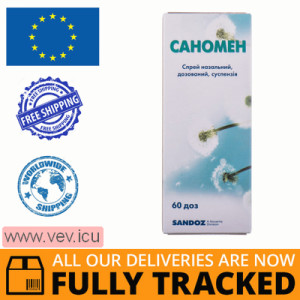
Sanomen nasal spray 50 mcg/dose, 60 doses — Made in Slovenia — Free Delivery


US and the Rest of the World: 9 to 20 business days
Description Sanomen nasal spray 50 mcg/dose, 60 doses — Made in Slovenia — Free Delivery
Pharmacological properties
Pharmacodynamics. Mechanism of action. mometasone furoate is a local corticosteroid with a local anti-inflammatory effect, manifested in doses that do not cause systemic effects.
Basically, the mechanism of anti-inflammatory and anti-allergic action of mometasone furoate is associated with its ability to suppress the release of mediators of allergic reactions.
Mometasone furoate significantly reduces the release of leukotrienes from leukocytes in patients with allergic diseases. In cell culture, mometasone furoate showed high activity in suppressing the synthesis and release of IL-1, IL-5, IL-6 and TNF-α; it is also a potent inhibitor of leukotriene production. In addition, it is a very potent inhibitor of the production of Th2 cytokines, IL-4 and IL-5, from human CD4 + T cells.
High anti-inflammatory activity of mometasone furoate was revealed both in the early and late stages of the allergic reaction. This is confirmed by a decrease (compared with placebo) in the level of histamine and eosinophil activity, as well as a decrease (compared to the baseline) in the number of eosinophils, neutrophils and adhesion proteins of epithelial cells.
In 28% of patients with seasonal allergic rhinitis, mometasone furoate showed a clinically significant onset of action within 12 hours after the first application. On average (50%), improvement occurred within 35.9 hours.
Children. During a one-year placebo-controlled clinical study in which children (n = 49 / group) were treated with mometasone furoate at a dose of 100 μg 1 time per day, no inhibition of the growth rate was observed.
Data on the safety and efficacy of mometasone furoate in children aged 3–5 years are limited, so an appropriate dose range cannot be established.
In a study involving 48 children aged 3-5 years, treated with mometasone furoate in doses of 50; 100 or 200 μg / day intranasally for 14 days, there were no significant differences compared with placebo in the mean change in the level of cortisol in blood plasma in response to test stimulation with tetracosactrin.
The European Medicines Agency waived the right to demand compliance with the obligations to transfer research results on the use of mometasone furoate in all subgroups of children for the treatment of seasonal or perennial allergic rhinitis.
Pharmacokinetics. Suction. The bioavailability of mometasone furoate when used in the form of a nasal spray is 1% in blood plasma (according to data obtained using a method with a lower quantification limit of 0.25 pg / ml).
Distribution. Mometasone is very poorly absorbed when administered intranasally.
Metabolism. A small amount that can be swallowed and which can be absorbed is completely metabolized on the first pass through the liver.
Excretion. Absorbed mometasone furoate is completely metabolized, and metabolites are excreted in urine and bile.
Indications
Treatment of seasonal or perennial allergic rhinitis in adults and children over 2 years of age.
It is recommended to start prophylactic treatment of moderate to severe allergic rhinitis 4 weeks before the expected start of the dusting season.
As an auxiliary therapeutic agent in the treatment of acute sinusitis with antibiotics in adults (including the elderly) and children over the age of 12 years.
Elimination of symptoms of acute sinusitis without signs of severe bacterial infection in adults and children over the age of 12 years.
Treatment of nasal polyps and related symptoms, including nasal congestion and loss of smell, in patients over the age of 18.
Application
Sanomen is intended for nasal use only.
Before using the preparation, it should be calibrated. Calibration is carried out by approximately 10 pushes of the dosing device, during which a stereotyped delivery of the preparation is established, in which approximately 100 mg of a suspension containing 50 μg of mometasone (1 dose) is emitted with each press.
If the nasal spray has not been used for 14 days or longer, re-spray with 2 clicks until full delivery is achieved before reapplying.
Treatment of seasonal or perennial allergic rhinitis. For adults (including the elderly) and children over 12 years of age, the recommended prophylactic and therapeutic dose of the preparation is 2 injections (50 mcg each) into each nasal passage once a day (total daily dose - 200 mcg). After achieving a therapeutic effect for maintenance therapy, it is advisable to reduce the dose to 1 injection in each nasal passage once a day (total daily dose - 100 mcg).
If the weakening of the symptoms of the disease cannot be achieved by using the preparation in the recommended therapeutic dose, the daily dose can be increased to the maximum: 4 injections into each nasal passage once a day (total daily dose - 400 mcg). After the symptoms of the disease have subsided, a dose reduction is recommended.
The preparation demonstrated a clinically significant onset of action within 12 hours after the first use in some patients with seasonal allergic rhinitis. However, the full benefit of the treatment cannot be obtained in the first 48 hours, so the patient must continue to use it regularly to achieve the full therapeutic effect.
For children aged 2–11 years, the recommended therapeutic dose is 1 injection (50 mcg) into each nasal passage once a day (total daily dose - 100 mcg).
Adjunctive treatment of acute sinusitis. For adults (including the elderly) and children over the age of 12, the recommended therapeutic dose is 2 injections (50 mcg each) into each nasal passage 2 times a day (total daily dose - 400 mcg).
If the weakening of the symptoms of the disease cannot be achieved by using the preparation in the recommended therapeutic dose, the daily dose can be increased to 4 injections into each nasal passage 2 times a day (total daily dose - 800 mcg). After the symptoms of the disease have subsided, a dose reduction is recommended.
Acute rhinosinusitis. For adults and children over the age of 12, the recommended therapeutic dose is 2 injections (50 mcg each) into each nasal passage 2 times a day (total daily dose - 400 mcg).
Nasal polyps. For patients over the age of 18 (including the elderly), the recommended dose is 2 injections (50 mcg each) into each nasal passage 2 times a day (total daily dose - 400 mcg). After achieving the clinical effect, it is recommended to reduce the dose to 2 injections into each nasal passage once a day (total daily dose - 200 mcg).
Contraindications
Hypersensitivity to the active substance or any other auxiliary components.
The preparation should not be used if there is an untreated localized infection involving the nasal mucosa, such as herpes simplex.
Since corticosteroids have the effect of inhibiting wound healing, patients who have recently undergone surgery in the nasal cavity or who have had injuries should not use nasal corticosteroids until healing occurs.
Side effects
Adverse reactions associated with the use of mometasone furoate (≥1%), observed during studies in patients with allergic rhinitis or nasal polyposis and during post-marketing use, are presented.
Adverse reactions are classified according to organ systems and frequency of occurrence. The incidence of adverse reactions is determined as follows: very often (≥1 / 10), often (≥1 / 100–1 / 10), infrequently (≥1 / 1000–1 / 100), isolated cases (≥1 / 10,000– 1/1000), rarely (1/10 000), the frequency is unknown (cannot be established from the available data).
From the respiratory system: very often - epistaxis1; often - nosebleeds, throat irritation, irritation of the nasal mucosa, burning sensation of the nasal mucosa, ulceration of the nasal mucosa; frequency unknown - perforation of the nasal septum.
General disorders and local reactions: often - headache; isolated - hypersensitivity reactions; rarely - anaphylaxis, angioedema, impaired sense of smell and taste.
Infections and infestations: often - pharyngitis, upper respiratory tract infections 2.
Immune system disorders: frequency unknown - hypersensitivity, including anaphylactic reactions, angioedema, bronchospasm and dyspnea.
From the nervous system: often - headache.
From the digestive tract: often - throat irritation1, abdominal pain, diarrhea, nausea; frequency unknown - disorders of taste and smell.
From the side of the organ of vision: the frequency is unknown - glaucoma, increased intraocular pressure, cataract, central serous chorioretinopathy, blurred vision.
1It was noted when used 2 times a day for the treatment of nasal polyposis; noted often in the treatment of rhinosinusitis.
2Noted infrequently when used twice a day for the treatment of nasal polyposis.
Description of some of the adverse reactions. Nosebleeds stopped spontaneously, were insignificant and occurred somewhat more often than with placebo (5%), not more often than with other investigated nasal corticosteroids used as active control (up to 15%). The incidence of all other adverse reactions was comparable to the incidence of adverse reactions with placebo.
In patients treated for nasal polyposis, the overall incidence of adverse reactions was similar to that observed in patients with allergic rhinitis.
The systemic effects of nasal corticosteroids are more likely to occur when used in high doses and over a long period.
Children. In children, the frequency of reported adverse reactions in studies, for example, nosebleeds (6%), headache (3%), irritation of the nasal mucosa (2%) and sneezing (2%), was comparable to that with placebo.
special instructions
The use of the preparation in young children should be carried out with the help of adults.
The preparation should not be used in the presence of untreated local infection with involvement of the nasal mucosa in the process.
Because corticosteroids have the effect of inhibiting wound healing, patients who have recently had nasal surgery or who have been injured should not be given a nasal corticosteroid until healing has taken place.
Sanomen nasal spray should be used with caution in patients with open or closed form of tuberculosis of the respiratory tract, untreated fungal, bacterial, systemic viral infections.
After 12 months of treatment with mometasone furoate, the patients showed no signs of atrophy of the nasal mucosa, in addition, mometasone furoate helped to normalize the histological picture of the nasal mucosa.
Despite this, patients who have been taking mometasone furoate for several months or longer should be examined periodically to detect possible changes in the nasal mucosa. In case of development of a local fungal infection of the nose or pharynx, therapy with mometasone furoate should be discontinued or appropriate treatment should be carried out. Irritation of the nasal and pharyngeal mucosa, which lasts for a long time, may also be an indication for discontinuation of treatment.
Mometasone furoate is not recommended for use in case of perforation of the nasal septum.
During the studies, a high incidence of nosebleeds was recorded compared with placebo. The nosebleeds stopped on their own and were minor.
Although the preparation controls nasal symptoms in most patients, concomitant use of appropriate adjunctive therapy may further reduce the severity of other symptoms, in particular eye symptoms.
However, care should be taken when treating patients transferred from long-term use of systemic corticosteroids to Sanomen.
Stopping the intake of systemic corticosteroids in such patients can lead to insufficiency of the adrenal cortex for several months until the function of the hypothalamic-pituitary-adrenal system is restored.
If these patients have symptoms of adrenal insufficiency or withdrawal symptoms (eg, joint and / or muscle pain, fatigue and depression) despite the absence of nasal symptoms, systemic corticosteroids should be resumed and another regimen should be applied. A change in therapy can also reveal allergic diseases, such as allergic conjunctivitis, eczema, which developed earlier and were masked by systemic GCS therapy.
When switching from the treatment of systemic corticosteroids to treatment with the Sanomen nasal spray, some patients may experience symptoms of corticosteroid withdrawal (for example, joint and / or muscle pain, fatigue and depression).
The safety and efficacy of mometasone furoate has not been investigated in the treatment of unilateral polyps, polyps associated with cystic fibrosis, and polyps that completely occlude the nasal cavity.
Additional evaluation should be done for unilateral polyps that are atypical, especially in the presence of ulcers or bleeding. Patients using corticosteroids may have decreased immune reactivity, and they should be warned about the increased risk of infectious diseases (eg, chickenpox, measles), as well as the need to consult a doctor if contact with such patients took place.
After the use of intranasal corticosteroids, in very rare cases, cases of perforation of the nasal septum or increased intraocular pressure have been reported.
Systemic effects of intranasal corticosteroids may occur when used mainly in high doses for a long time. These phenomena are much less likely than with the use of oral corticosteroids, and may differ in individual patients and with the use of different GCS. These include: Cushing's syndrome, cushingoid symptoms, adrenal suppression, stunted growth in children and adolescents, cataracts, glaucoma, and in more rare cases, a range of psychological or behavioral changes, including psychomotor hyperreactivity, sleep disturbance, anxiety, depression, or aggression (especially in children).
Sanomen Nasal Spray contains benzalkonium chloride, which can irritate the nasal mucosa. With prolonged use, the preservative benzalkonium chloride can cause swelling of the nasal mucosa. In the event of such a reaction (persistent nasal congestion), if possible, preference should be given to nasal forms of the preparation without a preservative. If such preparations are not available, you should switch to using the preparation in a different dosage form.
Treatment in doses higher than recommended can lead to clinically significant adrenal suppression. In the case of using the preparation in doses exceeding the recommended ones, it is necessary to provide for additional systemic use of corticosteroids during periods of stress or planned surgical intervention.
Regular growth monitoring is recommended in children receiving long-term nasal corticosteroid therapy. If the child's growth is stunted, therapy should be reviewed to reduce the dose of nasal corticosteroids, if possible, to the lowest effective dose to control symptoms. In addition, it is recommended to consult a pediatrician.
Visual impairment can be recorded with systemic and local use of corticosteroids. If the patient has symptoms such as blurred vision or other visual impairments, he should be advised to see an ophthalmologist to assess possible causes, which may include cataracts, glaucoma, or rare conditions such as central serous chorioretinopathy (CSCH) that have been reported after use systemic and local corticosteroids.
Acute rhinosinusitis: Patients should be warned to seek immediate medical attention if signs or symptoms of severe bacterial infection develop, such as fever, severe unilateral facial pain or toothache, orbital or periorbital swelling / edema, or worsening after initial improvements.
Use during pregnancy and lactation. Special studies of the effect of the preparation in pregnant women have not been carried out.
Like other corticosteroids for intranasal use, the preparation Sanomen is used in pregnant and breastfeeding women only if the expected benefit from its use outweighs the potential risk to the mother, fetus or infant. Infants whose mothers used GCS during pregnancy should be carefully examined for possible adrenal hypofunction.
Children. When conducting studies in children in whom mometasone furoate was used in a daily dose of 100 mcg for a year, growth retardation was not observed.
The safety and efficacy of mometasone furoate in the treatment of nasal polyps in children under the age of 18, symptoms of rhinosinusitis in children under the age of 12 have not been investigated; seasonal or perennial allergic rhinitis - in children under 2 years of age.
The ability to influence the reaction rate when driving or working with other mechanisms. Unknown.
Interactions
The preparation sanomen was used simultaneously with loratadine, with no effect on the plasma concentration of loratadine or its main metabolite, and mometasone furoate was not detected in the blood plasma even at the minimum concentration. The patients tolerated the combination therapy well.
Combination therapy with CYP 3A inhibitors, including preparations containing cobicistat, is expected to increase the risk of systemic side effects. Combined use should be avoided unless the benefit outweighs the increased risk of systemic side effects of GCS, in which case patients should be monitored for the occurrence of systemic side effects of GCS.
Overdose
Since the systemic bioavailability of mometasone furoate is 1%, it is unlikely that in case of an overdose, other measures will be required besides monitoring the patient's condition followed by the use of the preparation at the recommended dose.
Inhalation or oral administration of excessive doses of corticosteroids can lead to inhibition of the function of the hypothalamic-pituitary-adrenal system.
Storage conditions
At a temperature not higher than 25 ° C. Keep out of the reach of children. do not freeze.
Tags: Sanomen
Products viewed

2 x DERMENA REGENAIL SERUM NAIL CONDITIONER 7 ML - MADE IN POLAND - FREE SHIPPING
Product descriptionNourishing serum for nails dermena regenail is a specialist care product based on an active complex of natural oils (Natural Oil Complex) of: myrrh, cotton, almond, canola and wheat germ. This complex has also been enriched with a vitamin repair complex (vitamins A, E, F and C) an..
$31.45

CooperVision Frequency 55 Aspheric (6 lenses) DIA 14.40, BC 8.70 — Made in USA — Free Delivery
Frequency 55 Aspheric monthly contact lensesFrequency 55 Aspheric are monthly contact lenses from Cooper Vision.Unlike ordinary spherical contact lenses, Frequency 55 Aspheric improve the quality of vision even in low light conditions, e.g. when driving at night.These lenses work well in a variety o..
$90.02

Olimp L-Carnitine 1500 Extreme Mega Caps, 120 capsules — Made in Poland — Free Delivery
Product descriptionL-Carnitine 1500 Extreme mega caps is a concentrated dietary supplement in the form of capsules supplementing the diet with a high dose of L-carnitine. L-carnitine mediates the transport of fat-fatty acid components to energy centers, such as mitochondria. Each capsule of the prod..
$43.82
Nacomi Algae mask blueberry with vitamin C 40 g — Made in Poland — Free Delivery
Product descriptionAlgae masks have a strong revitalizing and rejuvenating effect. Perfectly cleanse the skin. They are perfect for the care of aging and flabby skin. They deeply stimulate and moisturize skin cells.The algae face mask with blueberry reduces redness and brightens the skin of the face..
$21.88
Buyers Online
- Customer from Trieste logged in
- Customer placed a new order for NIMESIL 2G X 30 SACHETS 100 MG — MADE IN GERMANY — FREE SHIPPING
- Customer from Brooklyn updated their account details
- Customer from Brooklyn logged in
- Customer from Strongsville logged in
- Customer from Brooklyn updated their account details
- Customer from Brooklyn placed a new order for VOLTAREN MAX GEL 180G - MADE IN SWITZERLAND - FREE SHIPPING
- Customer from Brooklyn logged in
- Customer placed a new order for DEBUTIR FORTE 60 СAPS — MADE IN POLAND- FREE SHIPPING
- Customer from Ottawa updated their account details
- Customer from Ottawa registered for an account
- Customer placed a new order for STRESAM 50MG 60 PILLS - MADE IN FRANCE - FREE SHIPPING
- Customer placed a new order for ACNE-DERM Cream 2p x 20Gr — Made in Poland by Uniapharm — Free Delivery
- Customer placed a new order for Ascorbic acid 0,05g 2p x 160 tablets — Made in Ukraine — Free Delivery
- Customer placed a new order for Fanigan 100 tablets — Made in India — Free Delivery
- Customer from Raleigh placed a new order for Essentiale Forte 300 mg, 2p x 50 capsules — Made in Poland — Free Delivery
- Customer from Raleigh logged in
- Customer placed a new order for TENOTEN FOR CHILDREN 40 PILLS — MADE IN LITHUANIA — FREE SHIPPING
- Customer from Raleigh logged in
- Customer placed a new order for Aqua Maris for Children from Birth nasal drops 10 ml — Made in Croatia — Free Deliver