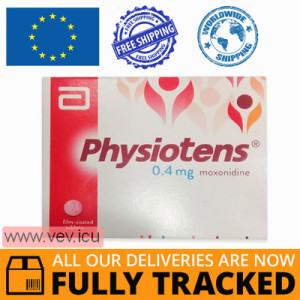
Physiotens 0.4mg 28 tablets — Made in France — Free Delivery


US and the Rest of the World: 9 to 20 business days
Description Physiotens 0.4mg 28 tablets — Made in France — Free Delivery
Pharmacological properties
Pharmacodynamics. Moxonidine has been proven to be an effective antihypertensive agent. the available experimental data indicate that the site of the antihypertensive action of moxonidine is CNS. moxonidine is a selective agonist of imidazoline receptors. these imidazoline-sensitive receptors are concentrated in the rostral region of the ventrolateral part of the medulla oblongata, a region considered to be the center of regulation of the peripheral sympathetic nervous system. stimulation of imidazoline receptors reduces the activity of the sympathetic nervous system and lowers blood pressure.
Moxonidine differs from other sympatholytic antihypertensive agents in its relatively low affinity for known α2-adrenergic receptors compared to imidazoline receptors. Due to this, sedation and dry mouth with moxonidine are rare.
In humans, the use of moxonidine leads to a decrease in OPSS with a subsequent decrease in blood pressure. The antihypertensive effect of moxonidine has been demonstrated in double-blind, placebo-controlled, randomized trials. Published data indicate that the use of an angiotensin II (AAII) antagonist together with moxonidine in patients with arterial hypertension with left ventricular hypertrophy with a decrease in the same blood pressure level made it possible to achieve an increase in the regression of left ventricular hypertrophy in comparison with the free combination of thiazide and a calcium channel blocker.
In therapeutic studies lasting 2 months, compared with placebo, moxonidine increased the insulin sensitivity index by 21% in patients with moderate arterial hypertension, obesity, and insulin resistance.
Pharmacokinetics. Absorption. After oral administration, moxonidine is rapidly (the time to reach Cmax in blood plasma is about 1 hour) and is almost completely absorbed in the upper gastrointestinal tract. The absolute bioavailability is about 88%, which indicates the absence of significant metabolism during the primary passage through the liver. Simultaneous food intake does not affect the pharmacokinetics of moxonidine.
Distribution. The degree of binding to blood plasma proteins, determined in vitro, is about 7.2%.
Biotransformation. Only dehydrogenated moxonidine was identified in human plasma samples. The pharmacodynamic activity of dehydrogenated moxonidine is about 1/10 that of moxonidine.
Excretion. Over a 24-hour period, 78% of the total dose of moxonidine is excreted in the urine as an unchanged compound and 13% as dehydrogenated moxonidine. Other minor metabolites in urine account for about 8% of the dose. Less than 1% is excreted in the feces. T½ of moxonidine and its metabolite is about 2.5 and 5 hours, respectively.
In patients with arterial hypertension compared with healthy individuals, the pharmacokinetics of moxonidine did not differ significantly.
In elderly people, changes in pharmacokinetics were noted, most likely due to a reduced level of metabolism and / or slightly higher bioavailability. However, these changes are not considered clinically significant.
Since moxonidine is not recommended for the treatment of children, pharmacokinetic studies have not been performed in this subpopulation.
Elimination of moxonidine is largely dependent on creatinine clearance. In patients with moderate renal impairment (glomerular filtration rate - 30-60 ml / min), stable plasma concentration and T1 / 2 are approximately 2 and 1.5 times higher than in patients with normal renal function (glomerular filtration rate 90 ml / min ). In patients with severe renal insufficiency (glomerular filtration rate 30 ml / min), stable plasma concentration and T½ is approximately 3 times higher. In these patients, no accumulation of moxonidine was detected after repeated use. In patients with end-stage renal failure (glomerular filtration rate 10 ml / min) who are on hemodialysis, plasma AUC and T½ are approximately 6 and 4 times higher, respectively, compared with hypertensive patients with normal renal function. In patients with moderate renal insufficiency, Cmax of moxonidine in blood plasma is only 1.5–2 times higher.
Based on the above data, the dose of moxonidine for patients with renal insufficiency should be selected individually. Moxonidine is excreted to a small extent during hemodialysis.
Preclinical safety data. In preclinical data, no particular risk to humans has been identified based on the results of standard studies on pharmacological safety, chronic toxicity, genotoxicity, carcinogenic potential and reproductive toxicity. Animal studies have shown toxic effects on embryonic development at doses that are toxic to the maternal body. Reproductive toxicity studies have shown no effect on fertility or teratogenic potential. Toxic effects on embryonic development were observed in rats at doses ≥9 mg / kg / day and rabbits at doses above 0.7 mg / kg / day. In studies of peri- and postnatal development in rats, an effect on development and viability was noted at doses ≥3 mg / kg / day.
Indications
Arterial hypertension
Application
The standard starting dose of moxonidine is 0.2 mg / day. the maximum single dose is 0.4 mg. the maximum daily dose is 0.6 mg in 2 divided doses. the dose should be selected individually, depending on the patient's response.
Physiotens can be taken with or without food, with a small amount of liquid.
For patients with moderate or severe renal impairment, the starting dose of moxonidine is 0.2 mg / day. If necessary and if the preparation is well tolerated, the dose can be increased to 0.4 mg / day for patients with moderate renal failure and up to 0.3 mg / day for patients with severe renal failure (see SPECIAL INSTRUCTIONS).
For patients on hemodialysis, the initial dose of Physiotens is 0.2 mg / day. If necessary and if the preparation is well tolerated, the dose can be increased to 0.4 mg / day.
Contraindications
Physiotens is contraindicated in:
hypersensitivity to the active substance or any component of the preparation;
sick sinus syndrome;
bradycardia (at rest 50 beats / min);
AV blockade II and III degree;
heart failure.
Side effects
The most common side effects with moxonidine include dry mouth, dizziness, asthenia, and drowsiness. the severity of these symptoms often diminishes after the first few weeks of treatment.
The following are grouped by classes of body systems and distributed by frequency of adverse reactions noted in placebo-controlled clinical trials in 886 patients who used moxonidine: very often (≥1 / 10), often (≥1 / 100, 1/10), infrequently (≥1 / 1000, 1/100).
From the nervous system: often - headache *, dizziness / vertigo, drowsiness; infrequently - fainting *.
From the side of the cardiovascular system: infrequently - bradycardia, hypotension * (including orthostatic hypotension).
On the part of the organ of hearing and the labyrinth: infrequently - ringing in the ears.
From the gastrointestinal tract: very often - dry mouth; often - diarrhea, nausea / vomiting / dyspepsia.
On the part of the skin and subcutaneous tissue: often - rash, itching; infrequently - angioedema.
From the musculoskeletal system and connective tissue: often - back pain; infrequently - neck pain.
From the side of the psyche: often - insomnia; infrequently - nervousness.
General disorders and reactions at the injection site: often - asthenia; infrequently - edema.
* Frequency not increased compared to placebo.
Special instructions
In the post-registration period, cases of av-blockade of varying severity were reported in patients taking moxonidine. therefore, a causal role of moxonidine in av-conduction delay cannot be completely ruled out. therefore, caution is advised when treating patients with a tendency to develop av-blockade.
Patients with grade I AV block should use moxonidine with extreme caution to avoid bradycardia. Moxonidine should not be used in patients with a higher degree of AV block (see CONTRAINDICATIONS).
Moxonidine should be used with caution in patients with severe coronary artery disease or unstable angina pectoris, since the experience of using the preparation in such patients is limited.
It is recommended to use moxonidine with caution in patients with impaired renal function, since moxonidine is excreted mainly by the kidneys. Such patients are advised to carefully titrate the dose, especially at the beginning of therapy. Treatment should be started with a dose of 0.2 mg / day; the dose can be increased to a maximum of 0.4 mg / day for patients with moderate renal impairment (glomerular filtration rate 30 ml / min, but 60 ml / min) and a maximum of 0.3 mg / day for patients with severe renal impairment (glomerular filtration 30 ml / min), if it is clinically indicated and the preparation is well tolerated.
If Physiotens is used in combination with a β-adrenergic receptor blocker and both preparations must be canceled, the β-adrenergic receptor blocker should first be canceled, and then, after a few days, Physiotens.
At present, there have been no manifestations of withdrawal effects from blood pressure after discontinuation of moxonidine. However, abrupt cessation of moxonidine therapy is not recommended; instead, the dose should be gradually reduced over 2 weeks.
Patients with isolated hereditary diseases such as galactose intolerance, lactase deficiency or glucose-galactose malabsorption should not take this preparation.
The ability to influence the reaction rate when driving or working with other mechanisms. Studies on the effect of the preparation on the ability to drive vehicles or work with mechanisms have not been carried out. Cases of drowsiness and dizziness have been reported when using the preparation. This should be taken into account when performing the indicated actions.
Application during pregnancy or lactation
Pregnancy. There are no relevant data regarding the use of moxonidine in pregnant women. Animal studies have shown an embryotoxic effect. The possible risk to humans is unknown. Moxonidine should not be used during pregnancy unless clearly needed.
Lactation. Moxonidine passes into breast milk, so it should not be used during breastfeeding. If moxonidine therapy is considered absolutely necessary, breastfeeding should be discontinued.
Children. Physiotens is not recommended for use in children due to insufficient data on the safety and efficacy of the preparation in this group.
Interactions
The simultaneous use of the preparation with other antihypertensive preparations leads to an additive effect.
Since tricyclic antidepressants can reduce the effectiveness of centrally acting antihypertensive preparations, the simultaneous administration of these preparations with Physiotens is not recommended.
Moxonidine can enhance the sedative effect of tricyclic antidepressants (simultaneous administration should be avoided), tranquilizers, alcohol, sedatives and hypnotics.
Moxonidine moderately increases cognitive impairment in patients receiving lorazepam. Moxonidine can enhance the sedative effect of benzodiazepines when used simultaneously.
Moxonidine is eliminated by tubular excretion. Interactions with other agents that are excreted by tubular excretion cannot be ruled out.
Overdose
Overdose symptoms. in some cases, an overdose of moxonidine, even at a dose of 19.6 mg taken at a time, did not lead to death. signs and symptoms of overdose include headache, sedation, drowsiness, hypotension, dizziness, asthenia, bradycardia, dry mouth, vomiting, fatigue, pain in the upper abdomen. in case of severe overdose, careful monitoring of impaired consciousness and respiratory depression is recommended. based on studies of the use of high doses of the preparation in animals, in addition, the appearance of temporary hypertension, tachycardia and hyperglycemia can be expected.
Necessary measures for overdose. No specific antidotes are known. In the case of hypotension, the use of dopamine and the introduction of plasma-substituting solutions are recommended to support blood circulation. When bradycardia appears, atropine can be used.
Antagonists of α-adrenergic receptors can reduce the severity or eliminate the paradoxical hypertensive effects of moxonidine overdose.
Storage conditions
Physiotens tablets 0.2 mg - store at a temperature not exceeding 25 ° c, Physiotens tablets 0.3 and 0.4 mg - store at a temperature not higher than 30 ° c. Keep out of the reach of children.
Tags: Physiotens
Products viewed
2 x ROSTIL 250MG 30 TABS — MADE IN POLAND — FREE SHIPPING
Indications: treatment of the symptoms of chronic venous insufficiency of the lower limbs (varicose veins): pain, cramps, tingling, swelling, skin changes due to blood stasis.Composition: 1 tablet contains: active substance: 250mg of calcium dobesylate monohydrate and excipients: lactose monohydrate..
$24.08

STEPER MEDICATED NAIL POLISH 10ML — MADE IN POLAND — FREE SHIPPING
Composition according to INCIPropane-Butane, Alcohol denat., Propylene Glycol, Thymus vulgaris extract, PEG-7 Glyceryl Cocoate, Eucalyptus Globulus Leaf Oil, Clotrimazole, Triclosan, Melateuca Alfernifolia (Tea Tree) Leaf Oil.Destiny* Protection against onychomycosis.* Cares for the damaged nail pla..
$19.57
MILDRONATE 500 MG 60 CAPS - MADE IN LATVIA - FREE SHIPPING
Capsules "Mildronate" are used in complex therapy in the following cases:diseases of the heart and vascular system: stable exertional angina, chronic heart failure (NYHA I-IIII functional class), cardiomyopathy, functional disorders of the heart and vascular system;acute and chronic ischemic disorde..
$76.67

Valocordin oral drops 50ml — Made in Germany — Free Delivery
IndicationFunctional disorders of the cardiovascular system; neuroses accompanied by increased irritability and a sense of fear; psychosomatically caused anxiety; states of excitement with pronounced vegetative manifestations; sleep disturbance.ApplicationIt is prescribed for adults. used internally..
$200.00
Physiotens 0.4mg 14 tablets — Made in France — Free Delivery
Pharmacological propertiesPharmacodynamics. Moxonidine has been proven to be an effective antihypertensive agent. the available experimental data indicate that the site of the antihypertensive action of moxonidine is CNS. moxonidine is a selective agonist of imidazoline receptors. these imidazoline-..
$21.88
Buyers Online
- Customer from Brooklyn updated their account details
- Customer from Brooklyn logged in
- Customer from Strongsville logged in
- Customer from Brooklyn updated their account details
- Customer from Brooklyn placed a new order for VOLTAREN MAX GEL 180G - MADE IN SWITZERLAND - FREE SHIPPING
- Customer from Brooklyn logged in
- Customer placed a new order for DEBUTIR FORTE 60 СAPS — MADE IN POLAND- FREE SHIPPING
- Customer from Ottawa updated their account details
- Customer from Ottawa registered for an account
- Customer placed a new order for STRESAM 50MG 60 PILLS - MADE IN FRANCE - FREE SHIPPING
- Customer placed a new order for ACNE-DERM Cream 2p x 20Gr — Made in Poland by Uniapharm — Free Delivery
- Customer placed a new order for Ascorbic acid 0,05g 2p x 160 tablets — Made in Ukraine — Free Delivery
- Customer placed a new order for Fanigan 100 tablets — Made in India — Free Delivery
- Customer from Raleigh placed a new order for Essentiale Forte 300 mg, 2p x 50 capsules — Made in Poland — Free Delivery
- Customer from Raleigh logged in
- Customer placed a new order for TENOTEN FOR CHILDREN 40 PILLS — MADE IN LITHUANIA — FREE SHIPPING
- Customer from Raleigh logged in
- Customer placed a new order for Aqua Maris for Children from Birth nasal drops 10 ml — Made in Croatia — Free Deliver
- Customer from Raleigh logged in
- Customer from Raleigh placed a new order for Essentiale Forte 300 mg, 2p x 50 capsules — Made in Poland — Free Delivery